FUNDAMENTALS
Nutrition and Exercise
Nutrition and exercise: the optimal combination
Whether you want to lose, maintain or gain weight, nutrition, rest and training are inseparable. We achieve the best results with clients committed to all three. This blog focuses on nutrition and explains how and why it gives you substantial influence over your results.
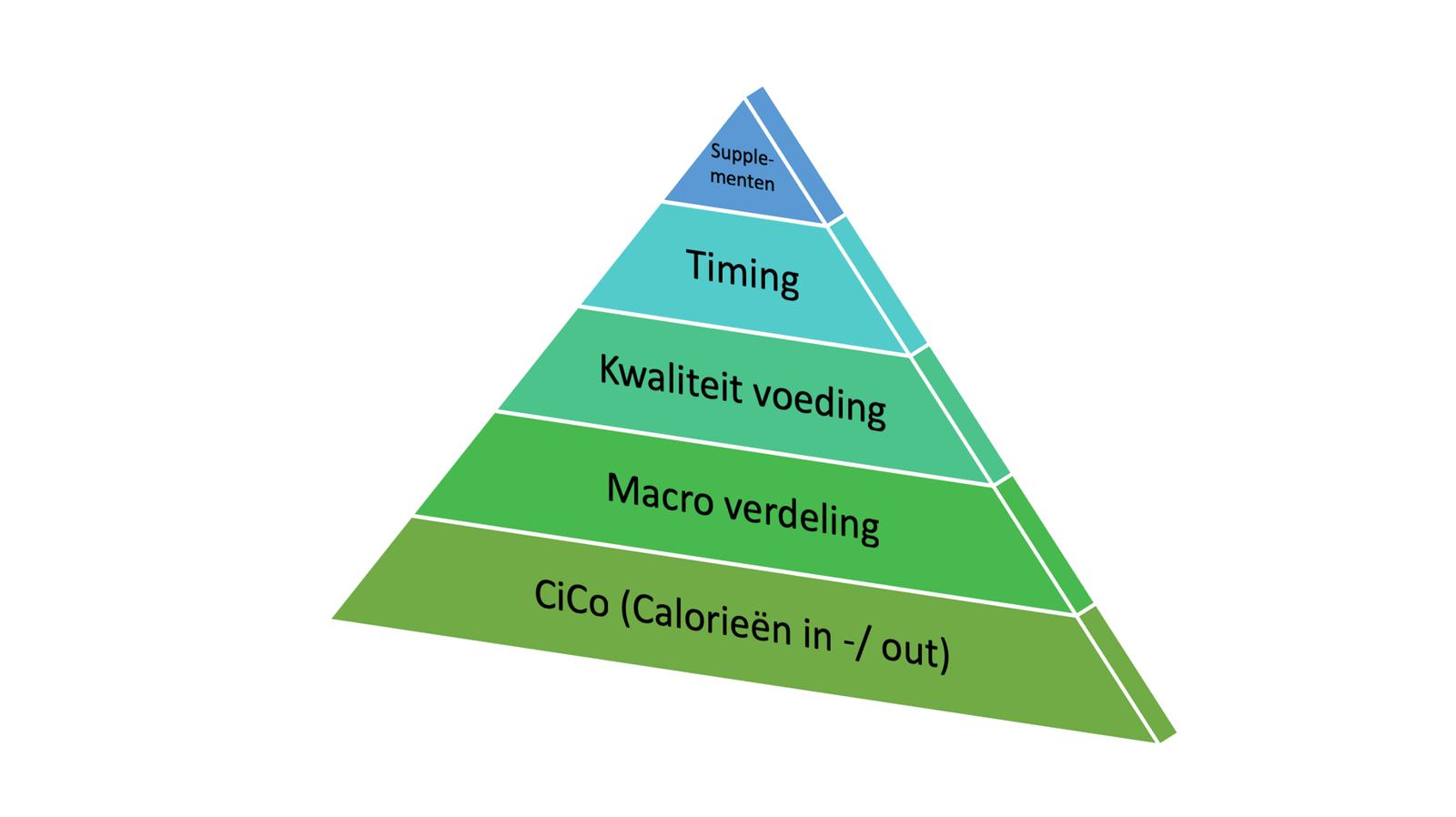
A Maslow-style pyramid provides a useful overview of where the greatest gains can be made: at the bottom, in the foundation. The higher levels matter too, but the base matters most.
Counting calories: measurement brings understanding
CICO refers to calories consumed and expended. A calorie is a physical unit of energy that our bodies use as fuel. You consume calories to fuel movement, through both food and drink. To understand how many you expend, start with your resting energy needs. Even if you spend all day watching Netflix, you still burn calories—good news! This is your basal metabolic rate, or BMR.
To calculate BMR, you need your weight and body fat percentage. If you do not know your body fat percentage, use the Harris–Benedict formula. Online calculators use sex, height, age and weight, although this is less accurate. If you know your body fat percentage, you can calculate your weight excluding fat: your fat-free mass.
How do you calculate it?
We use the Katch–McArdle formula to calculate calorie needs. It is suitable for men and women:
BMR in kcal = 370 + (21.6 × fat-free mass)
If you do not know your exact body fat percentage, use the Harris–Benedict formula to estimate daily calorie needs. Online tools include this energy-requirement calculator.
Your BMR shows how many calories you burn while doing nothing. You also move and train, so next comes the activity factor. If you train three to five times a week, multiply your BMR by 1.55 to estimate what your body needs. Use 1.25 for one or two sessions a week, 1.4 for two or three, and 1.6 for more than five.
To lose weight, eat fewer calories than you expend. Multiply the activity-adjusted figure by 0.80 for a 20% deficit: enough to lose weight without going hungry. To gain mass, multiply it by 1.2 for a 20% surplus that gives your muscles the opportunity to grow.
Use these figures to assess your food intake. Eating above your activity-adjusted needs makes weight gain likely, and the reverse applies too. Excuses cannot defeat these simple physical principles, so track your intake and learn about yourself.
Do not track for so long that it becomes obsessive. A week can already provide enough insight to make changes. If you would like us to do this with you or want nutritional guidance, we offer tailored support.
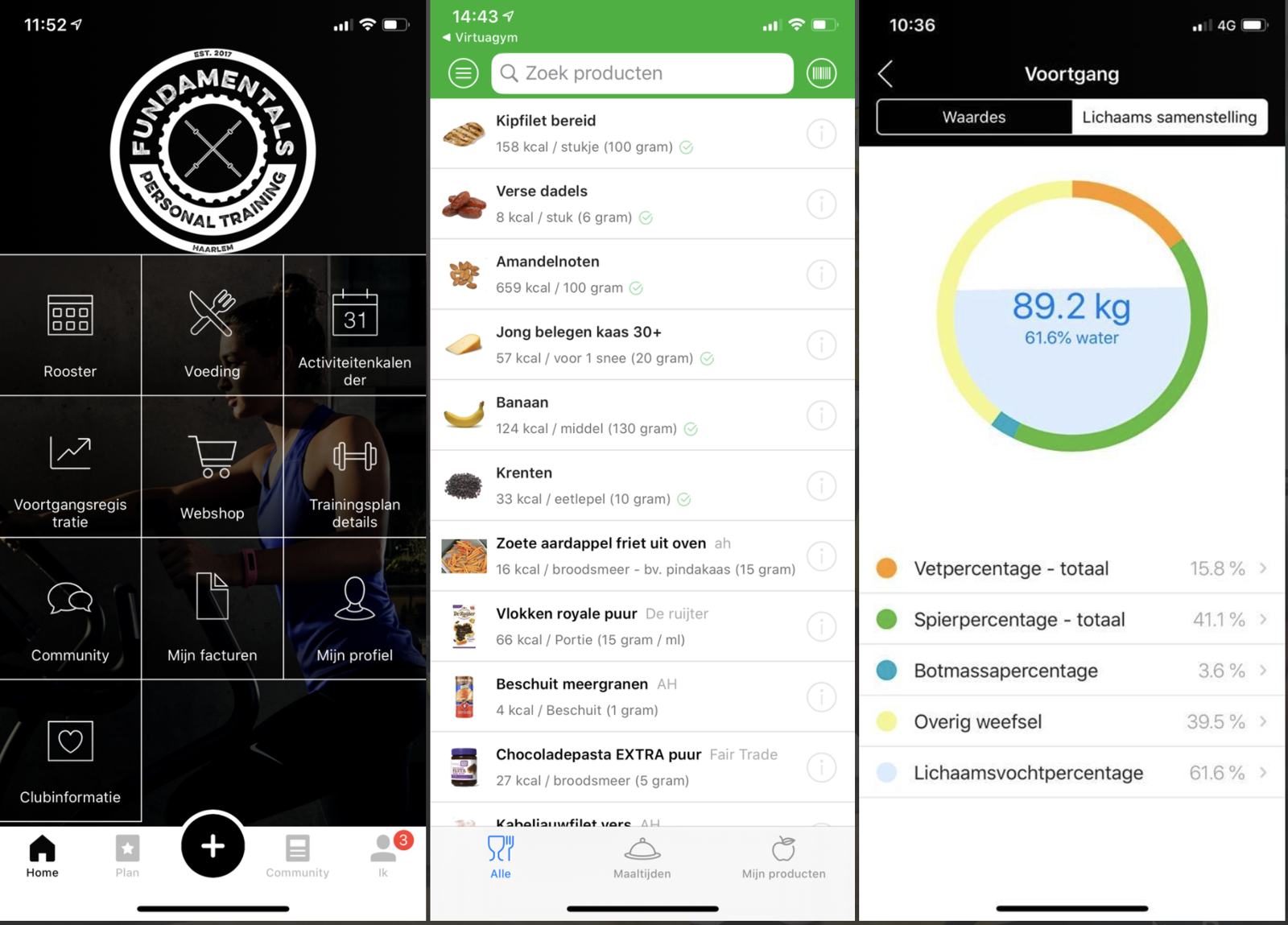
Once you know your calorie target, enter it into a tracking app such as MyFitnessPal or Virtuagym's Food app. Read on to learn about macros, the second level of the pyramid.
Building muscle rather than relying on cardio for weight loss
An attentive reader may already see it: increasing BMR lets you eat more without gaining weight. How? Adding muscle increases body weight and therefore BMR, meaning you burn more energy even on a day spent watching Netflix. If you then eat less, you reduce body fat faster. Strength training is therefore the most sustainable way to lose weight. To learn how to approach it, book a Kickstart with our personal trainers.
Macro distribution and good nutrition
This is often confusing. The field keeps changing. The longer I work in sport, the more supposed “truths” I see overturned—except that your back should not round during a deadlift; that always remains true. Fat used to be the enemy; now carbohydrates are. If you believe the Netflix documentary Game Changers, popular among keen exercisers, animal proteins are merely intermediaries that disrupt your blood values.
In my view, a varied diet based on nutritious foods matters. Carbohydrates provide energy, protein helps develop muscle, and fats are essential because a large part of the brain is fat. Especially with intense exercise, I believe in the value of a paleo diet. If you can pick it, dig it up, catch it or gather it, it fits. Otherwise, it does not. Venison steak is excellent; iced biscuits less so.
Read more about macros in this blog.
You can experiment with this. Different diets and trends work for different people. Consider the ketogenic diet, common in polar regions where little vegetation grows. Inuit communities catch fish and live largely on such foods, putting the body into ketosis. Without carbohydrates, the body's easiest available energy stores run out and it must adapt. It looks for other reserves: excess calories stored as fat become fuel. But is this manageable every day?
What does the personal trainer do?
I would not choose this for myself. I want enough energy to sustain a busy life of work, family and exercise. I do best with sufficient carbohydrates, often complex sources such as oats and wholemeal bread. And yes, I enjoy a stroopwafel now and then.
I invite you to experiment with your macro distribution. If plenty of protein suits you, go for it. Try something new. Change is not necessarily bad physically: shaking things up has an effect on your body.
Another quick win for a healthy weight: eat your calories rather than drinking them, and combine everything with vegetables. Good luck!
Food quality
There is a difference between an intensively reared chicken and one from an organic farm. A chicken raised under artificial light cannot have lived a natural, healthy life and cannot offer you the same benefits as an organic one. Potatoes offer choices too. For convenience, you may buy them peeled. A peeled potato, like other produce, loses its protection. Cut an avocado and leave it for a day to see what happens. Potatoes still need to sell, and consumers find brown ones less attractive. The solution is preservatives. You have a choice here.
Earlier, I mentioned nutritional value: 100 kcal of kidney beans differs considerably from 100 kcal of bread, even though both provide fibre-rich carbohydrates and protein.
Another nutrition trend, and not without reason: changing meal timing can work well for many people. Not everyone, but try it if you want a change.
In my view, meal timing can help with weight loss. Removing a substantial eating period often unintentionally reduces total daily calories. “But for years we were told breakfast starts the metabolism.” That is true. It also often leaves you wanting a mid-morning snack. Removing breakfast and a snack reduces calorie intake, often by around 500 kcal—certainly with my breakfast. A longer period without food also affects hormones, with less insulin circulating, influencing fat storage.
The best diet is one you can maintain
There are disadvantages. The most obvious is whether you can sustain it in a world full of temptation. It reduces flexibility. Training in the evening and then going through the night and morning on an empty stomach can be difficult. After hard training, your body needs calories to repair the damage caused by exercise. Without food, it remains under stress longer, negatively affecting your hormonal system.
Again, timing matters, but less than CICO. It can work extremely well for some and less well for others. Find what suits you.
Supplements
Stop spending hundreds of euros every month on products you do not need. Much of it is marketing theatre. Get protein from food, eat a varied diet to obtain the necessary nutrients, and only choose supplements when needed, for example if you have symptoms.
You might choose vitamins to support immunity during darker months, essential fats such as omega-3 if you do not eat enough fish, or magnesium for cramps or substantial post-exercise soreness. Use whey protein only as a backup when you lack time to eat protein-rich meals. Supplements are not miracle products. Eat good food and invest in useful nutrition books instead of trusting glossy supplement websites.
Written by:
Thijs Avezaat — owner
Author's note: an occasional beer is absolutely fine. We are still human. And yes, I am looking forward to summer!

Written by
Start here
Three sessions with a coach. No strings attached.
Keep reading